
OBITUARY
Amar Jit Singh
October 11, 1938 – December 6, 2021
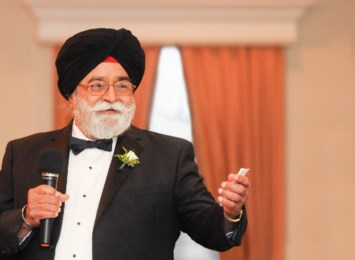
“He no longer belongs to us. He belongs to the ages.” Upon the recent death of Dr. Amar Jit Singh, 83, family members used this historic phrase to describe their patriarch, who passed away peacefully on December 6, 2021, in Fairfax Virginia.
Amar Jit lived an incredible life, from humble beginnings in rural India, to earning a Ph.D. in the United States, to becoming a fixture within his community, he touched the lives of many people. Known in America as “AJ,” in India as “TT,” and to his children and grandchildren as “Papa Ji” and “Lupa Ji,” Amar Jit approached life with a razor-sharp mind, kindness, and a jovial spirit that enchanted those around him.
Born in Lyallpur, India (present day Faisalabad, Pakistan), in 1938, Amar Jit was born into a devout Sikh family. His father, Dr. Sajjan Singh Malik, was a general practitioner in rural Punjab who rode his bicycle to remote areas to visit his patients. Known for his compassion, stoicism, and good looks, one of his most significant accomplishments was laying the foundation stone for the Guru Teg Bahadur Hospital in Ludhiana, India. Amar Jit’s mother, Bibi Harbajan Kaur, was a primary school teacher, homemaker, mother, and activist for Indian independence from Britain.
The fourth of six children in his family, Amar Jit had three older siblings, all of whom have since passed away: brother Charanjit (“Chilu”), sister Joginderpal (“Raj”), and sister Surinder (“Guddi”). Close in age to Guddi, and attending many of the same schools, he treated her as a second mother. He is survived by his two younger brothers, Damanjit (“Lalu”) and Narinder (“Neche”).
A precocious child, Amar Jit exhibited a studious, playful, yet respectful attitude toward his siblings, peers, and teachers. At the age of four, a large bale of hay fell on, and broke, his leg causing him to be immobilized for the better part of a year. The physical scar of the incident would remain his entire life, serving as a fitting symbol of the fortitude he would later exhibit.
Later in childhood, he and his family were forced to migrate, as refugees, as a result of the Partition of British India. Partition caused millions of Sikhs and Hindus to migrate from present day Pakistan to India, and millions of Muslims to travel in the opposite direction. More than 15 million people were uprooted, while an estimated one to two million migrants died as a result of violence and other causes. The family lived in a tent city in Kurukshetra, India, while his father worked as a medical officer for refugees. They later moved to Patiala, India, and again to Mahendragarh, India, where Amar Jit attended high school.
Amar Jit attended Pilani College in Rajistan, India, where he graduated with a B.E. in electrical engineering in 1960. In what he described as one of his greatest accomplishments, he was one of four Indians selected for a prestigious position as an apprentice engineer at a firm in Manchester, England, signaling the first time he, or anyone in his family, would leave the Indian subcontinent.
After completing his apprenticeship, Amar Jit enrolled in the University of Birmingham, where in 1967, he would earn an M.Sc. in Operations Research, the field to which he would dedicate his career. While in Europe, Amar Jit traveled across the continent and particularly enjoyed Scandinavia. Although mesmerized by the culture, architecture, and climate in Europe, he also missed his family in Punjab and struggled with bronchitis, as a result of the sulfur content in the coal-burning fireplaces.
He would continue his westward travel, by visiting the World’s Fair in Montreal, Canada, in 1967. It was there he tried his first slice of pizza, calling it “the most delicious food I have ever eaten.” With what little money he had, he bought a second slice.
He eventually immigrated into the United States and enrolled in a master’s degree program at Case Western Reserve University in Cleveland, OH. Graduating with an M.S. in Operations Research in 1969, he would also later complete his Ph.D. in the same field.
According to preserved letters, he was “impressed with the size of the cars in America, the high-rise buildings, freeways (in England they call them ‘motorways’) and above all the use of neon lights at night to show your businesses, restaurants, etc.”
In 1970, he returned to India and was introduced by his sister and brother-in-law to his future wife, Dilpreet, in passing. Initially unaware of the purpose of the introduction, he later agreed that he would like to marry her. Her reaction to the brief encounter was similar; she found him funny and was impressed by the opportunities available to her in the United States. Married on January 25, 1970, they were together for 51 years until his passing. Their marriage would be marked by moves across the world, laughter, daily commutes together, extensive viewing of Zee TV, two children, and six grandchildren.
Living together in Cleveland on graduate student stipends of $350 per month, Amar Jit was conscious of their tight budget, and ever mindful about his own modest upbringing. He would be fervent in his commitment to frugality, a principal to which he would adhere for the rest of his life. At the time, their weekly indulgence was a Big Mac (49 cents) with no fries.
Needing a car, he borrowed money from a friend to buy a used 1964 hardtop Ford Mustang. A careful driver, his car was nevertheless dinged by others’ four times. He would never get the car fixed, instead opting to conserve cash. He was once pulled over for a misaligned bumper; he convinced the officer to help him put the bumper back in place and then was free to go.
Ph.D. in hand, in 1972, Amar Jit obtained a position at a hospital with the Veterans Administration (now known as the Department of Veterans Affairs, “DVA”) in Brentwood, CA, where he helped the hospital’s operations. He also taught courses at the University of California Los Angeles (UCLA), the University of Southern California (USC), and California State University (Cal State), Fullerton. Later, he would also teach at Johns Hopkins University and the George Washington University.
Flush from dual incomes, as well as teaching roles, the couple’s fortunes improved significantly, and in 1976, they bought a home in West Hills, CA, which had a view of the entire San Fernando Valley. When lit up at night, the valley reminded Amar Jit of Diwali back home. The same year, the couple’s first son, Rick Inder (“Rick”), was born.
Upon accepting another position at the DVA in 1979, the family of three moved to the Washington, D.C. area, but retained the house in West Hills as a rental, along with buying three other rental properties. In total, they would accumulate six rental properties, which they would eventually liquidate in order to build their dream home.
In 1980, their second son, Jas Jeet (“JJ”), was born and they settled down in Virginia, eventually building their forever home in 1988 in Fairfax Station. In this location, Amar Jit and Dilpreet were active in the Sikh community, becoming original members of the Sikh Foundation of Virginia (SFV), built nearby. Amar Jit was elected chairman and self-deprecatingly remarked, “I didn’t do the greatest job, but it was good enough.”
He eventually retired from the DVA as the Director of Statistics and Analysis. One of the staples of his retirement included walking in Springfield Mall (now the Springfield Town Center). He, along with other retirees, formed a walking group called ROMEO, which according to Amar Jit, stood for “Retired Old Men, E something, O something.” Toward the end of his life, even though his body wore down, his mind remained acute, quizzing his grandchildren on math problems and helping them with puzzles.
Amar Jit is remembered not only for his professional accomplishments, but also his compassion. As an immigrant, and former refugee, he understood the plight of other migrants and tutored at-risk youth. He also had a robust sense of humor, which was occasionally self-deprecating, but he also appreciated a good joke and rewarded others with hearty laughter.
Amar Jit was a loyal friend and family member, remarking for many years about the kindness of so many, including Mr. Surinder Sikand and Mr. Ajeet Sood who helped him and Dilpreet when they lived in Cleveland, as well as Mr. John Peel and Mr. Denis Lyons, who were his close friends while he studied in the United Kingdom. He remained very close to his relatives in the United States and India and had a close relationship with his brother-in-law in India, Dr. Narinder Baweja. He also successfully sponsored many relatives from India to immigrate into the United States.
Originally a fan of the Washington Football Team, he would later informally adopt the Baltimore Ravens, not because he liked the team, but rather because he found a 2 for $20 deal on Baltimore Ravens’ Starter jackets at Modell’s in Springfield Mall. He wore one for more than a decade, and thought of sending the second one to India, with a recipient to-be-identified. The whereabouts of the second jacket are unknown. Frugality fully on display, he was also a connoisseur of eight-dollar Casio watches, which he wore religiously.
His favorite show was Three’s Company, followed by Rachel Maddow on MSNBC. He eventually switched to HGTV, citing a desire to stop seeing bad news every day. His favorite song was Superstitious by Stevie Wonder, his favorite movie was Coming to America, and his favorite radio station was 106.7 WJFK where he listed to the Don & Mike Show on evening commutes. He loved hot and sour soup from Chopsticks in Huntsman Square, VA as well as Mexican food from On the Border in Woodbridge, VA.
He was proud of the professional and personal lives that his wife and two children built. Dilpreet earned three masters’ degrees, retired as the Director of Human Resources for the Office Academic Affiliations of the DVA, and remains active in the Sikh community. His oldest son, Rick, a University of Virginia graduate, is Managing Director and portfolio manager at JPMorgan. He is married to Simran Kaur and they have four children, Ajai, Daya, Seva, and Dani. His second son, JJ, a University of Virginia, Harvard Business School, and Harvard Kennedy School graduate, is President of Retreat Hotels & Resorts, a hotel development and management company. Amar Jit was proud that someone in the family had gone to Harvard, completing one of his dreams. JJ is married to Jessica Lewis and they have two children, Kiera, and Sarina.
An ardas for Amar Jit was held at the Sikh Foundation of Virginia on December 11, 2021. In lieu of flowers, Amar Jit requested donations to Pingalwara, a “home for the homeless, a hope for the forlorn, a hospital for the sick and a cradle for the orphaned and abandoned child” in Punjab, India. The family requests that anyone wishing to make such a donation should contact the family so the funds can be properly transmitted.
Show your support
Add a Memory
Share Obituary
Get Reminders
Services
SHARE OBITUARYSHARE
- GET REMINDERS
v.1.18.0